





PRESENTATION:
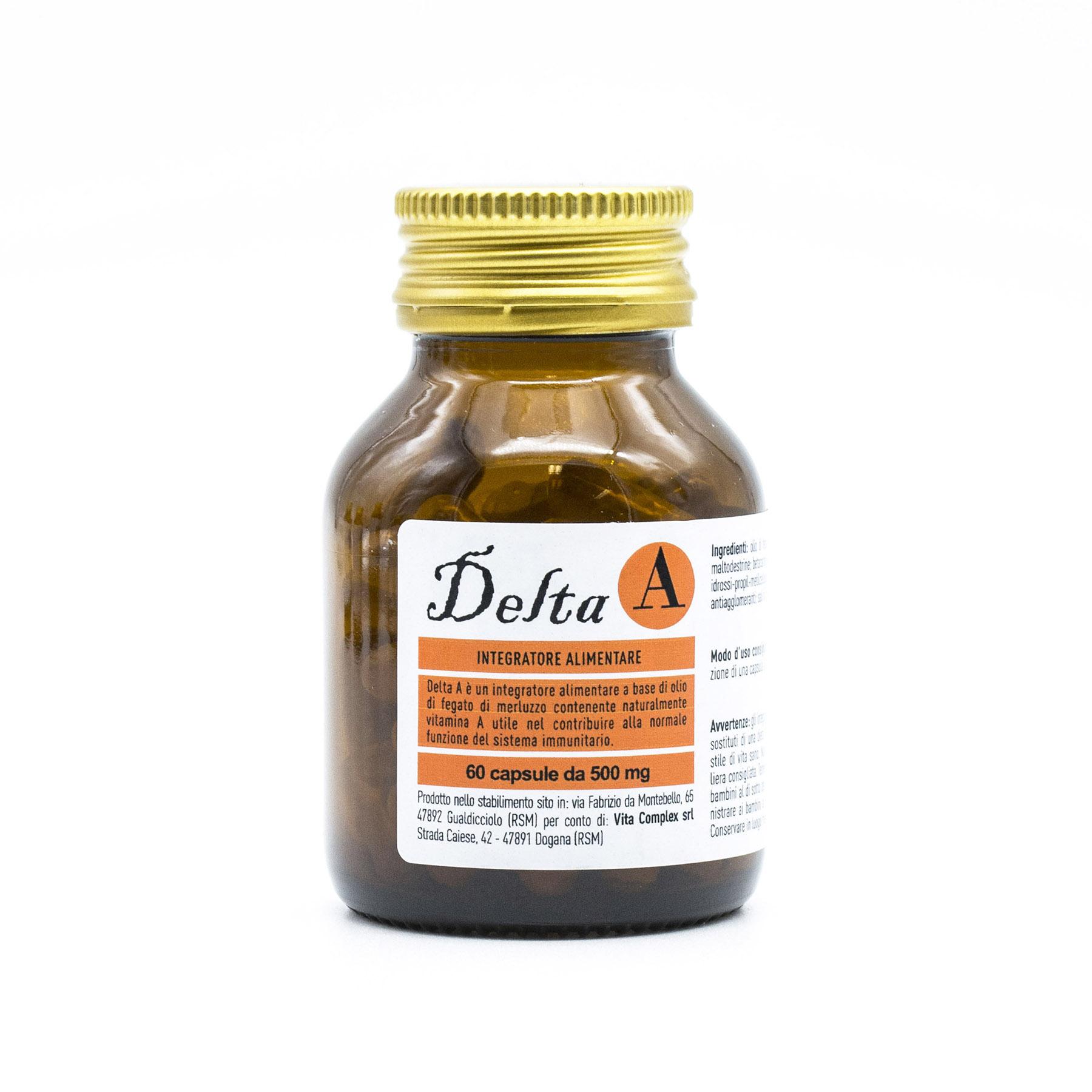
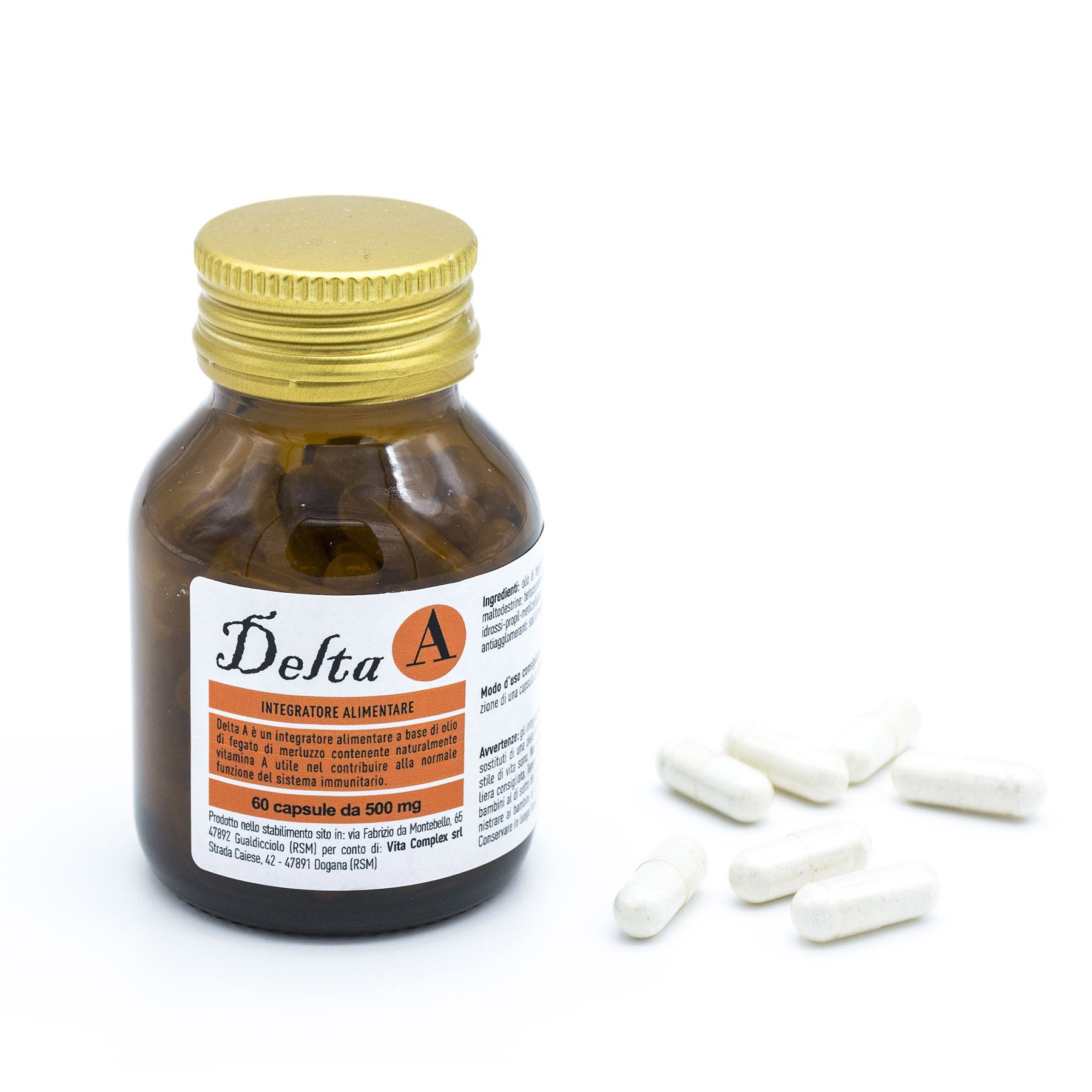
Flacon de verre teinté de 60 gélules.
PRECAUTIONS D’EMPLOI:
Ce produit n’interfère avec aucun médicament. Il peut être administré aux enfants à partir de 6 ans, aux personnes âgées et aux femmes enceintes. Il n’est pas recommandé de prendre ce complément en cas d’ insuffisance hépatique grave et/ou cirrhose.
INGREDIENTS PRINCIPAUX:
VITAMINE A 100% NATURELLE
HUILE DE FOIE DE MORUE
INGREDIENTS:
Huile de foie de morue (poisson); maltodextrine; bêta-carotène, gélule: gélatine alimentaire; anti-agglomérant: sels de magnésium d’acides gras.
Mis à jour: 19/11/2025
RÔLE DE SES CONSTITUANTS:
Notre vie moderne entraine une alimentation déséquilibrée. L’agriculture industrielle produit des aliments pauvres en éléments nutritifs, les médicaments provoquent des dysbioses chroniques ou aigues qui affectent l’absorption des vitamines et minéraux. L’alcool, le café, le tabac, le stress, le sucre, les contraceptifs, les antibiotiques, la chimiothérapie anti-cancéreuse sont les ennemis des vitamines. Les déficits nutritionnels s’accentuent avec l’âge. La conséquence est l’apparition de carences plus ou moins importantes chez l’ensemble de la population (OMS 1985). Le rétinol ou vitamine A possède des propriétés extraordinaires qui étonnent les chercheurs et les cliniciens du monde entier.
Son action est démontrée sur :
– la fonction visuelle
– la peau et les muqueuses
– la synthèse des mucopolysaccharides
– les membranes des lysosomes et les
mitochondries (cicatrisation)
– la reproduction
– l’immunité
– les maladies infectieuses et la sclérose en plaques
La vitamine A remplit de nombreuses fonctions fondamentales pour notre corps :
- contribue au fonctionnement normal du système immunitaire (2011; 09 (4) : 20)
- facilite la cicatrisation des plaies
- favorise la croissance et renforce les os et les dents
- maintient une vision normale (2010; 8 (10) : 1), en maintenant la cornée en bon état
- maintient la peau saine et protégée (2010; 8 (10) : 1) et empêche la formation d’acné
- nourrit les cellules épithéliales
- maintient les muqueuses normales (2010; 8 (10) : 1)
- favorise la maturation sexuelle et maintient la fertilité à l’âge adulte en améliorant le fonctionnement des systèmes testiculaire et ovarien
- facilite le métabolisme du fer (2009; 7 (9) : 12)
- intervient dans le processus de spécialisation de la cellule (2009; 7 (9) : 12)
QUELS SONT LES SYMPTOMES PROVOQUES PAR LES CARENCES ?
– Absence de larmoiement et irritation des yeux
– Diminution de la vision nocturne
– Sécheresse de la peau et des muqueuses
– Diarrhée
– Diminution de la résistance aux infections
– Perte de l’odorat
– Retard de la croissance.
CONSEILS D’UTILISATION:
nous recommandons de prendre une gélule par jour.
On peut prendre Delta A pendant ou en fin de repas (la présence de graisses favorise l’absorption du beta carotène).
On peut l’associer à la vitamine E et C.
Il est souhaitable de prendre Delta A en continu pour bénéficier de l’action préventive comme démontré par les travaux scientifiques.
BASI SIENTIFICHE – BIBLIOGRAFIA:
• BENJAMIN E., COHEN, I. KELMAN COHEN
Vitamin A: ajuvant and steroïd antagonist in the immune response. The journal of Immunology. Vol. III n°5, nov. 1973 : 1376-1380
• BOLLAG W.
Vitamin A and retinoïds : from nutrition to pharmacotherapy in dermatology and oncology. Lancet, 1983 : 860-863.
• BOLLAG W., HANCK A.
From vitamin A to retinoïds, modem trends in the field of oncology and dermatology. Acta vitamin. Enzymal.
1977,31 : 113-125.
• BOUTWELL RK., VERMA AF.
Effects of vitamin A and retinoïds on the biochemical processus linked to carcinogenesis. Pure Appl. Chem. 1979, 51 : 857-866.
• BROC P., STORA C., BERNHEIM L.
De I’emploi de la vitamine A dans le traitement des mastoses. Ann. Endocrin. 1956, 2 : 193-200.
• CHU EW., MALMGREN RA.
An inhibitory effect of vitamin A on the induction of tumors of forestomach an cervix in the Syrian hamster by carci-nogenic polycyclic hydrocarbons. Cancer Res. 1965, 25 : 884-885.
• COHEN SM., WITTENBERG JF., BRYAN GT.
Effects of avitaminosis A and hypervitaminosis A on urinary blodder carcinogenicity of N-(4-(5-Nitro-2. furyl)– 2-Thiazolyl) formide. Cancer Res. 1976, 36 : 2334-2339.
• DAVIES RE.
Effects of vitamin A on 7,12 – dimethylbenz(a) anthracene-induced papillomas in rhino mouse skin. Cancer Res. 1967, 50 : 439-444.
• DENNERT G.
Effects of retinoïc acid on the immune system : stimulation of T killer cell induction. Eur. J. Immunol. 1978, 8, n° 1 : 23-29.
• ELIAS PM., FRIENDS DS.
Vitamin A induced mucous metaplasia : an in vitro system for modulating tight and gap junction differenciation. J. Cell. Biol. 1976, 68 : 173-188.
• HAJJI QMAR
Cancers du sein métastaseés et vit. A. Thése Faculté de Bobigny 1984.
• HOGAN B.
Epithelial cancer, differenciation and vitamin A. Nature. 1979, 277 : 261-262.
• ISRAEL L., AGUILERA J.
Vitamine A et cancer. Path. Biol. 1980, 28, n° 4 : 235-259.
• ISRAEL L., EDELSTEIN R.
Plasmapheresis in patients with disseminated cancer = clinical results and correlation with changtes in serum pro-teins. The concept of non specific blocking factors. Cancer. 1977, 40, 6 : 3145-3146.
• IVAN CAMERON, BARRY GRUBLAS, WAID ROGERS
High-dose methyl prednisolone, vitamin A, and vitamin C in rats bearing the rapidly growing Morris 7777 hepa-toma. Cancer treatment reports, vol. 63, n° 3, march 1979.
• JEROME J., DECOSSE MD.
Potential for chemoprevention. Cancer. 1982, 50 : 2550-2553.
• MASSON KE.
Relation of vitamins to the sexolands, in ALLEN F., DANFORTH CH., DAISSY EA. (Edss) : sex and internal secretions. Baltimore, Williams et Wilteins CO, 1939.
• MC NUTT-NS.
Freeze-fracture techniques and applications to the structural analysis of the mammalian plassma membrane,
in Poste G., NICOLSON GL. (Ed) cell surface reviews. Amsterdam North Holland Publishing Co. 1977, vol. 4, pp 75-126.
• MC NUTT NS., WEINSTEIN RS.
Carcinoma of the cervix : deficiency of nexus intercellular junctions. Science 1979, 165 : 597-599.
• MlCKSCHE M., WRBA H.
Stimulation of immune response in lung cancer patients by vitamin A therapy. Oncology, 1977, 34 : 234-238.
• MOON RC., GRUBBS CJ., SPORN MB.
Retinyl acetate inhibits mammary carcinogenesis induced by N-methyl-N-nitrourea. Nature. 1977, 267 : 620- 621
• NETTESHEIM P., WILLIAMS ML.
The influence of vitamin A on the susceptibility of the rat lung to 3-methyl cholantrone. Int. J. Cancer. 1976, 17 : 351–387.
• O’BRIEN TG.
Induction fo ornithine decarboxylase as an early possibly obligatory event in mouse skin carcinogenesis.
Cancer Res. 1976, 36, 2644.
• O’BRIEN TG., SIMSIMAN RC., BOUTWELL RK.
Induction of polyamine-synthetic enzymes in mouse epidermis and their specificity for tumor promotion.
Cancer Res. 1975, 35 : 2426-2433.
• PRUNTKIN L.
Mucous metaplasia and gap junctions in the vitamin A acid treated skin tumor kerato acanthoma. Cancer Res. 1975, 35 : 364-369.
• RUSSEL DH., DURIE GM.
Polyamines as biochimical Markers of normal and malignant growth. New York, Rwen Press, 1978.
• SAFFIOTTI U., MONTESANO R., SELLAKUMAN AR.
Experimental cancer of the lung: inhibition by vitamin A of the induction of tracheobronchial squamous metaplasia and squamous cell tumors. Cancer. 1967, 20 : 857-864.
• SPORN MB., DUNLOP NM., NEWTON DL.
Prevention of chemical carcinogenesis by vitamin A and its synthetic analogs. Fed. Proc. 1976, 35 : 1332- 1338.
• SPORN MB., NEWTON DL.
Chemoprevention of cancer with retinoïds. Fed. Proc. 1979, 38 : 2528-2534.
• STEPP W.
Versuche über Futterung mit Lipoid frever Nahrurg. Biochem. Z. 1909, 22 : 452-460.
• TODARO GJ., DE LARCO E., SPORN MB.
Retinoïds block phenotypic cell transformation produced by sarcoma growth factor. Nature. 1978, 276 : 272- 274.
• TODARO GJ., HUEBNER RJ.
The vival oncogene hypothesis: New evidence. Proc. Nat. Acad. Sci. USA. 1972, 69 : 1009-1115.
• VENANZIE F., MONTENEGRO O.
Arachives brasil Med, 1947, 37 : 135-147 et Revista de obst. et Gyn. Brasil, 1947, 8 (n° 2) : 70-89.
• WEINSTEIN RS., MERK FB., ALROY J.
The structure and function of intercellular junctions in cancer. Adv. cancer. Res. 1976, 23 : 23-89.
• WOLBACH SB., HOWE PR. 1925
Tissue changes following deprivation of fat-soluble A vitamin. J. Exp. Med. 42 : 753-778.
• WOLBACH SB., HOWE PR.
Vitamin A deficiency in guinera-pig. Arch. Pathol. Lab. Med. 1928, 5 : 239-2563.
• BRANDES T., SATO S., VEDA H.
Radiation response of L1210 Leukemia cells pretreated with vitamin A ahohol.J. Nat. Cancer. Invest. 1974, 52 : 945–949.
• COHEN M., CARBONE P.
Enhancement of the antitumor effect of 1,3 bis 2 chloroethyl 1 nitrosourea and cyclophosphamide by vitamin A. J. Nat. Cancer. Inst. 1972, 48 : 921-926.
• NAKASHIMA T., NAGAI T., MAKISHIMA K., HIROTO I.
Primary culture of carcinoma of the maxillary sinus in human. Jibiinkoka Rinsho. 1978, 1 : 78-83.
• ALDO MARIANI COSTANTINI. CARLO CANNELLA, GIOVANNI TORNASSI:
Fondamenti di Nutrizione Umana. Il Pensiero Scientitico Editore.
• GOMBART AF. BORREGAARD N., KOEFFLER HP.:
Human cathelicidin antimicrobial peptide (CAMP) gene is a direct target of the vitamin D receptor and is strongly up-regulated in myeloid cells by 1,25-dihydroxyvitamin D3. FASEB J. 2005 Jul.19(9):1067-77.
(http://www.ncbi.nlm.nih.gov/entrez/query.
fcgi?db=pubmed&cmd=
Retrieve&dopt=AbstractPlus&list_uids=15985530&
query_hl=8&itool=pubmed_docsum)
• WANG TT., NESTEL FP., BOURDEAU V., NAGAI Y., WANG Q., LIAO J., TAVERA-MENDOZA L., LIN R., HANRAHAN JW., MADER S., WHITE JH., Cutting edge:
1,25-dihydroxyvitamin D3 is a direct inducer of antimicrobial peptide gene expression. J Immunol. 2004 Sep 1;173(5):2909-12. Erratum in: J Immunol. 2004 Nov 15;173(10):following 6489. Hanrahan. JH [corrected to Hanrahan, JW]. (http://www.ncbi.nlm.nih.gov/entrez/query. fcgi? db=pubmed&cmd=
Retrieve&dopt=AbstractPlus&list_uids=15322146&
query_hl=8&itool=pubrned_docsum)
• CANNELL JJ., VIETH R., UMHAU JC., HOLICK MF., GRANT WB., MADRONICH S., GARLAND CF., GIOVANNUCCI E.:
Epidemic influenza and vitamin D. Epidemiol Infect. 2006 Dec;134(6):1129-40. Epub 2006 Sep 7. (http://www.ncbi.nlm.nih.gov/entrez/query.fcgi? db=pubmed&cmd=Retrieve&dopt=
AbstractPlus&list_uids=16959053&
query_hl=14&itool=pubmed_docsum)
• LAPPE JM., TRAVERS-GUSTAFSON D., DAVIES KM., RECKER RP., HEANEY RP.:
Vitamin D and calcium supplementation reduces cancer risk: results of a randomized trial. Am J Clin Nutr. 2007 Jun;85(6):1586-91 (http://www.ncbi.nlm.nih.gov/sites/entrez? Db=pubmed&Cmd=ShowDetailView&TermToSearch=
17556697&ordinalpos=1&itool=EntrezSystem2.PEntre
z.Pubmed.Pubmed_ResultsPanel. Pubmed_RVDoc





Avis
Il n’y a pas encore d’avis.